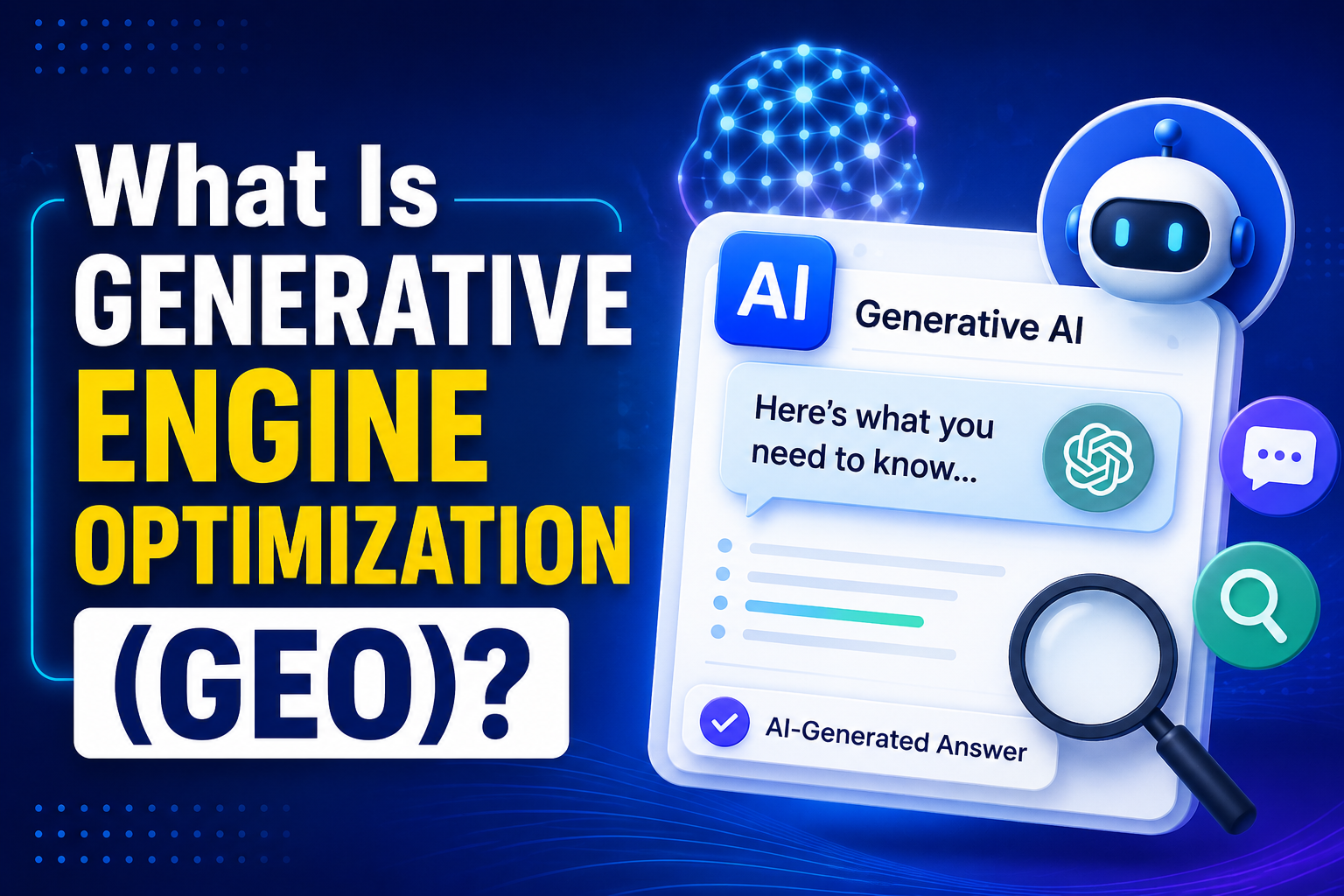
What Is Generative Engine Optimization (GEO)?
How to get your business mentioned by ChatGPT, Google AI Overviews, and other AI-powered answers.
Search behavior is shifting fast. Instead of typing a query into Google and clicking through ten blue links, more people are now asking AI tools directly and getting a single, synthesized answer. This shift is exactly why generative engine optimization has become one of the most important topics in digital marketing today — it's the practice of making sure your business gets cited, quoted, or recommended inside those AI-generated answers.
If you're already familiar with traditional seo, think of GEO as its natural evolution: same underlying goal of visibility, but built for a world where AI models — not just search engine result pages — decide what gets shown to the user.
GEO vs SEO: What's Actually Different?
Traditional seo is built around ranking a webpage on a results page, optimized through keywords, backlinks, and technical signals that search engine crawlers can read. Generative engine optimization, often shortened to geo, works differently — it optimizes content so AI models can understand, trust, and directly reference it when generating an answer, rather than just linking to it.
| Aspect | Traditional SEO | GEO |
|---|---|---|
| Goal | Rank high on the results page | Get cited inside the AI-generated answer |
| Primary Audience | Search engine crawlers | Large language models |
| Success Signal | Click-through rate, rankings | Citation, mention, or quote in AI output |
| Content Style | Keyword-optimized pages | Clear, well-structured, fact-dense content |
The important part: geo doesn't replace seo — it builds on it. A technically sound, well-structured site is still the foundation both traditional search engines and AI models rely on to trust your content.
Why GEO Matters Right Now
AI Answers Are Becoming the First Touchpoint
Google's AI Overviews, ChatGPT search, and Perplexity increasingly answer questions before a user ever visits a website.
Fewer Clicks, Higher Stakes
If your brand isn't mentioned in the AI's answer, you may lose the customer entirely — not just a ranking position.
Trust Signals Carry More Weight
AI models favor clear, well-sourced, structured content — making authority and clarity more valuable than keyword density alone.
Early Movers Get the Advantage
As with early seo adoption, businesses optimizing for geo now are more likely to be the ones AI models "learn to trust" first.
Academic research backs this shift too — a widely cited study from Princeton and Georgia Tech researchers on GEO found that specific content optimizations meaningfully increased how often sources were cited by generative AI systems, reinforcing that this is a measurable, distinct discipline from classic seo.
How to Optimize Content for GEO
Getting cited by AI systems isn't about gaming an algorithm — it's about making your content genuinely easy for a model to understand, verify, and quote confidently. Practical steps for GEO include:
- Answer questions directly and clearly near the top of the page, rather than burying the answer in long intros.
- Use structured data (Schema.org markup) so AI systems and search engines can parse facts, FAQs, and entities accurately.
- Include original data, statistics, or expert insight — AI models favor content that adds something beyond generic summaries.
- Maintain strong technical seo fundamentals, since a slow or poorly indexed site is harder for both crawlers and AI systems to access.
- Keep content factually consistent across your site, since contradictions reduce an AI model's confidence in citing you.
GEO, SEO, and Local Search Working Together
Generative engine optimization doesn't exist in isolation — it works best layered on top of strong seo fundamentals, including structured data, fast technical performance, and clear on-page content. If you're still building that foundation, our guide on SEO services for businesses worldwide covers the technical and local seo groundwork that makes geo far more effective once it's added on top.
Our Approach to GEO
At Gracewell, generative engine optimization is treated as an extension of our existing seo and content strategy work — not a separate, disconnected service. We audit how your brand currently appears (or doesn't) in AI-generated answers, strengthen the structured data and content clarity AI models rely on, and track citation visibility alongside traditional rankings. Explore our full range of digital marketing services to see how geo fits into a complete visibility strategy.
Frequently Asked Questions
Is generative engine optimization replacing SEO?
No. Geo builds on strong seo fundamentals — technical health, structured data, and quality content remain essential for both search engines and AI models.
Which AI platforms does GEO apply to?
GEO applies to AI systems like Google AI Overviews, ChatGPT search, Perplexity, and other generative answer engines that cite web sources.
How do I know if my content is being cited by AI tools?
Regularly querying relevant questions across AI platforms and tracking whether your brand or content is mentioned is currently the most reliable manual check, alongside emerging geo tracking tools.
Get Ahead of the Shift to AI Search
Talk to our team about building a GEO strategy alongside your existing SEO.
Consult Our ExpertsAuthor: Gracewell