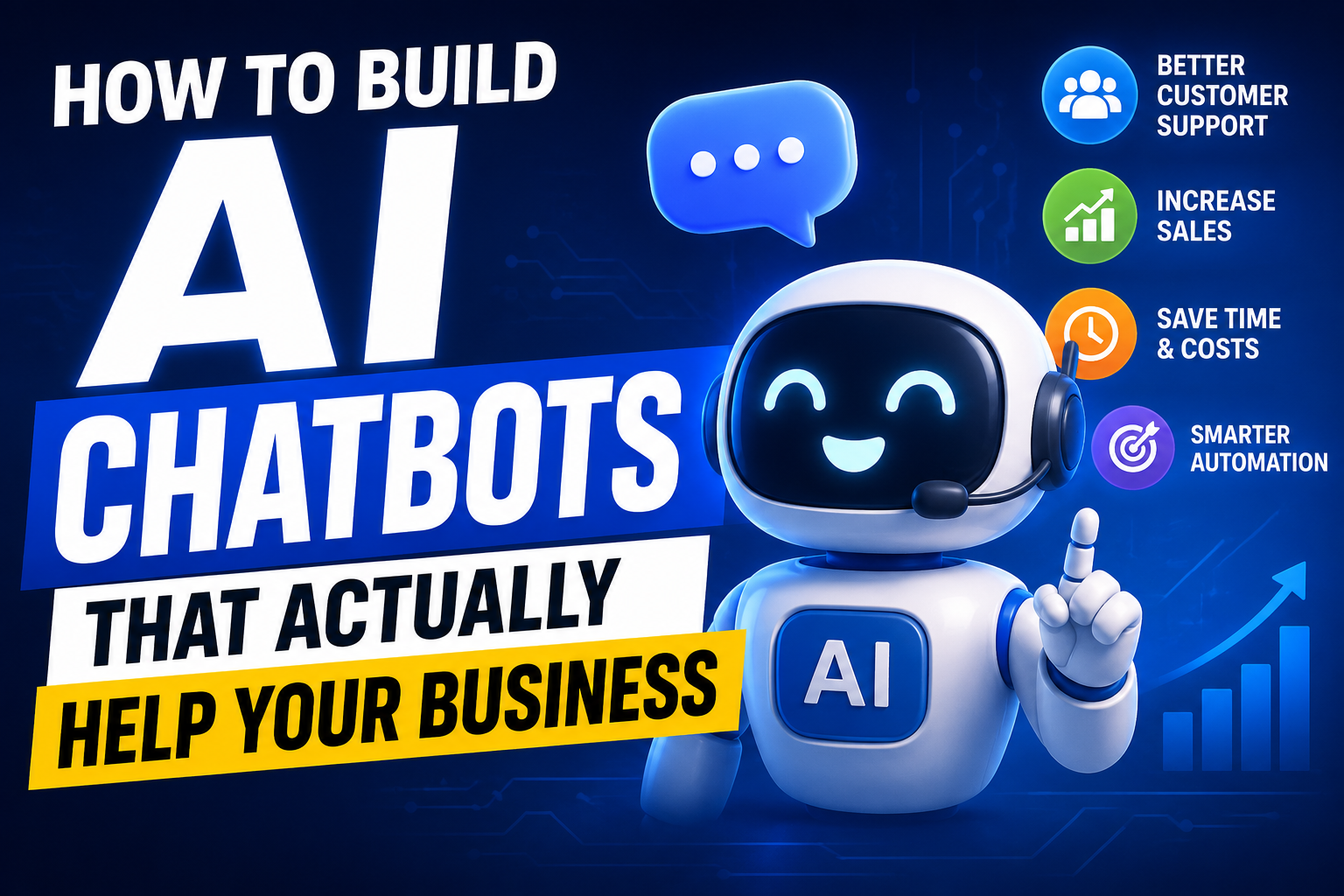
How to Build AI Chatbots That Actually Help Your Business
A practical, step-by-step guide to planning, designing, and launching AI chatbots that convert visitors into customers.
Customers now expect instant answers, any time of day — and that expectation is exactly why ai chatbots have moved from "nice to have" to a core part of how businesses handle support, sales, and lead generation. Whether you're exploring your first bot or replacing a clunky old one, understanding real chatbot development practices will save you months of trial and error.
This guide walks through what ai chatbots actually do, the benefits worth caring about, a realistic step-by-step build process, common mistakes to avoid, and a real-world example of chatbot development done right.
What Are AI Chatbots, Exactly?
An AI chatbot is a program that understands natural language and responds conversationally, using machine learning models rather than a fixed decision tree. Unlike old-style "press 1 for support" bots, modern ai chatbots can understand intent, hold context across a conversation, and hand off to a human when needed — making them useful across websites, WhatsApp, and in-app support widgets.
How a typical AI chatbot processes and responds to a message
Key Benefits of AI Chatbots for Businesses
24/7 Instant Support
Ai chatbots answer common questions instantly, any time of day, without customers waiting on hold or for email replies.
Lower Support Costs
Automating repetitive queries frees your support team to focus on complex issues that genuinely need a human.
Higher Lead Capture
A well-designed bot can qualify visitors, collect contact details, and route hot leads to sales in real time.
Consistent Brand Voice
Unlike a rotating support team, a chatbot delivers the same tone and accuracy in every single conversation.
Scalable Without Extra Hiring
Handle traffic spikes — sales, launches, festivals — without needing to staff up temporarily.
Actionable Conversation Data
Chat logs reveal what customers actually ask, surfacing product gaps and content opportunities.
How to Build AI Chatbots: Step-by-Step Process
Define the Bot's Job
Decide if it's for support, lead generation, bookings, or FAQs — trying to do everything at once is the fastest way to build a confusing bot.
Map Real Conversations
Pull your most common customer questions from support tickets, emails, and calls to build the bot's actual conversation flows.
Choose the Right Platform
Pick a chatbot framework or LLM-based platform based on your channels — website, WhatsApp, Instagram — and integration needs.
Connect Business Systems
Integrate your CRM, order system, or knowledge base so the bot gives accurate, up-to-date answers instead of generic ones.
Test With Real Users
Run the bot through real conversations, edge cases, and confusing phrasing before it goes live publicly.
Launch, Monitor & Improve
Track conversation logs weekly and refine responses — chatbot development doesn't stop at launch, it improves with real data.
Case Study: Chatbot Development for an Online Retail Business
A mid-sized online retail client came to us with a simple problem: their support inbox was overwhelmed with the same handful of questions — order status, return policy, and sizing — while genuinely complex issues sat unanswered for days. Our chatbot development process focused on the three highest-volume query types first, integrating directly with their order management system so the bot could pull real order data instead of giving generic replies.
Within the first full quarter after launch, the results were clear: faster response times, a lighter load on the support team, and noticeably fewer abandoned carts during checkout, since shoppers could get sizing and shipping questions answered instantly instead of leaving the site.
Common Mistakes in Chatbot Development
Trying to Automate Everything on Day One
Overloading a first version with too many use cases leads to a confused bot and a frustrating user experience.
No Clear Handoff to a Human
Chatbots that trap frustrated users in endless loops, with no path to a real person, damage trust fast.
Ignoring Conversation Data After Launch
Treating chatbot development as a one-time project instead of reviewing logs and improving responses regularly.
Skipping Real Testing
Launching without testing edge cases, typos, or unusual phrasing leads to embarrassing, unhelpful responses.
Generic, Robotic Tone
A bot that doesn't match your brand voice feels bolted-on rather than a natural part of the customer experience.
Related Reading
How technical and local SEO help your chatbot-driven site get found in the first place.
How custom WordPress and WooCommerce builds support chatbot integrations cleanly.
Why AI-driven visibility strategies matter alongside AI-driven customer experience.
See the full range of services we offer alongside chatbot development.
Browse recent projects across web development, SEO, and automation.
Frequently Asked Questions
What is the difference between a chatbot and an AI chatbot?
A basic chatbot follows fixed rules and menus, while ai chatbots use machine learning to understand intent and respond conversationally, even to phrasing they haven't seen before.
How long does chatbot development typically take?
A focused, single-purpose bot can take 3-5 weeks, while a more advanced bot with multiple integrations may take 8-12 weeks.
Do AI chatbots work on WhatsApp and Instagram, not just websites?
Yes — most modern ai chatbots can be deployed across websites, WhatsApp Business API, Instagram, and Facebook Messenger from a single backend.
Will a chatbot replace my support team?
No — the goal of chatbot development is to handle repetitive queries so your team can focus on complex, high-value conversations, not to remove human support entirely.
How much does it cost to build an AI chatbot?
Costs vary widely based on complexity and integrations — a simple FAQ bot costs far less than one connected to your CRM, inventory, and payment systems.
Can a chatbot be trained on my own business data?
Yes — modern ai chatbots can be trained or grounded on your product catalog, help docs, and policies so answers are accurate to your business specifically.
What happens if the chatbot doesn't understand a question?
Good chatbot development always includes a graceful fallback — either clarifying questions or a smooth handoff to a human agent.
Do I need coding knowledge to maintain a chatbot after launch?
Most platforms offer no-code dashboards for editing responses, though deeper integrations or logic changes typically still need a developer.
Are AI chatbots secure for handling customer data?
When built correctly, ai chatbots follow the same data security practices as the rest of your site — encrypted connections, access controls, and no unnecessary data storage.
How do I measure if my chatbot is actually working?
Track resolution rate, handoff rate, customer satisfaction after chats, and whether it's reducing ticket volume for the queries it was built to handle.
Thinking About Building an AI Chatbot?
Let's map out the right chatbot development approach for your business, step by step.
Consult Our ExpertsAuthor: Gracewell