
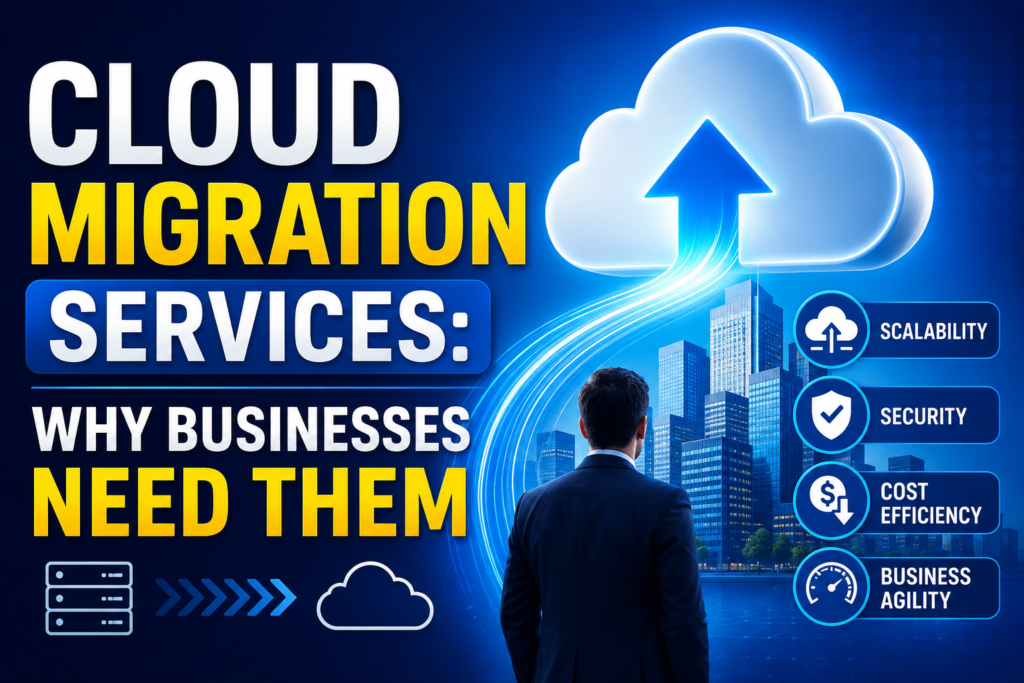
Cloud Migration Services: Why Businesses Need Them
In today's rapidly evolving digital economy, cloud migration services have become the cornerstone of business modernisation. Organisations that embrace cloud infrastructure gain the speed, security, and scale that define competitive success in 2026 and beyond.
What Are Cloud Migration Services?
Cloud migration services refer to the structured, end-to-end process of moving an organisation's digital assets — applications, databases, servers, and entire IT workloads — from on-premise infrastructure to a cloud environment. In 2026, this also includes transitions between cloud providers and the consolidation of multi-cloud environments for resilience and cost control.
Professional cloud migration services span every phase of the journey: infrastructure discovery and assessment, detailed migration planning, secure data transfer, configuration, testing, and post-migration optimisation. Leading platforms include Amazon Web Services (AWS), Microsoft Azure, and Google Cloud Platform (GCP).
Why Businesses Need Cloud Migration Services in 2026
Legacy infrastructure is now a strategic liability. Rising maintenance costs, security vulnerabilities, and incompatibility with modern AI and automation tools are forcing organisations to act. Investing in expert cloud migration services gives businesses instant access to elastic resources, world-class security, and a future-ready platform.
Elastic scalability
Auto-scale resources in seconds. Handle traffic surges, global launches, or viral demand without pre-purchasing idle hardware capacity.
Significant cost reduction
Eliminate capital expenditure on data centres and hardware. Pay-as-you-use pricing means you never pay for capacity you don't consume.
Enterprise-grade security
Zero-trust architecture, AI-driven threat detection, end-to-end encryption, and automated compliance built directly into the cloud platform.
Global remote accessibility
Empower distributed teams across every geography and time zone with seamless, fast, and reliable access to all business systems.
AI & automation access
The most impactful tools of 2026 — generative AI, ML pipelines, intelligent automation — run cloud-natively. Migration is the gateway.
Sustainability & ESG goals
Cloud providers run on renewable energy. Migration measurably reduces your carbon footprint and strengthens ESG reporting credentials.
Types of Cloud Migration
The right strategy depends on your application portfolio, timeline, budget, and long-term architecture vision. A qualified cloud migration services provider assesses each workload individually and recommends the most appropriate path — or a combination.
⇧ Rehosting — "Lift & Shift"
Move applications to the cloud with minimal code changes. Fastest route with immediate infrastructure savings. Ideal for legacy systems and time-sensitive migrations.
✎ Refactoring — Cloud-Native Rebuild
Redesign applications using microservices, containers, and serverless architecture for maximum performance and long-term cost efficiency.
⚙ Replatforming — Optimise & Move
Make targeted optimisations during migration without a full redesign. Significant cloud benefits with manageable complexity — the pragmatic middle path.
▶ Hybrid Cloud Migration
Combine on-premise infrastructure with cloud platforms for flexibility, data sovereignty requirements, or phased enterprise transitions.
The 5-Phase Cloud Migration Process
Successful cloud migration services follow a disciplined, phased methodology designed to minimise disruption, protect data integrity, and maximise value from day one. Skipping phases — especially assessment and piloting — is the leading cause of failed migrations.
Discover & Assess
Audit workloads, map dependencies, measure cloud readiness
Plan & Design
Select per-workload strategy and build a detailed roadmap
Pilot Migration
Migrate non-critical systems first and validate performance
Full Migration
Execute at scale with parallel systems and 24/7 monitoring
Optimise & Govern
Right-size, apply FinOps, enforce ongoing security governance
Common Challenges in Cloud Migration
Even well-planned migrations encounter predictable obstacles. Choosing an experienced partner means these challenges are anticipated and resolved before they impact business continuity or budget.
Sensitive data in transit needs end-to-end encryption, access controls, and adherence to GDPR, HIPAA, and data sovereignty laws.
Parallel-run strategies and automated cutover tools keep mission-critical systems live throughout all migration windows.
Older applications may need refactoring or middleware adaptation before running reliably on modern cloud infrastructure.
Without specialist knowledge, misconfiguration leads to cost overruns, security vulnerabilities, and performance bottlenecks.
Without FinOps governance, cloud spend spirals. Right-sizing, reserved instances, and cost dashboards are essential from day one.
A multi-cloud strategy protects long-term flexibility and negotiating power, preventing dangerous single-vendor dependency.
Industries Transformed by Cloud Migration Services
From healthcare to finance, virtually every sector is being reshaped by cloud adoption. The organisations leading their industries in 2026 moved earliest and most strategically.
Healthcare
Secure patient records, telemedicine, AI diagnostics
E-commerce
Scalable storefronts, real-time inventory, personalisation
Manufacturing
IoT, predictive maintenance, smart operations
Education
Virtual classrooms, adaptive platforms, global reach
Finance
Real-time transactions, fraud AI, compliance
Startups
Zero capex, global scale, day-one speed
How to Choose the Right Cloud Migration Services Partner
The quality of your migration partner determines the success of your cloud journey more than any other single factor. Look for a partner who invests time in understanding your business goals, regulatory environment, and technology roadmap — not just your server inventory.
- Proven track record across industries and workload types
- Certified expertise across AWS, Azure, and Google Cloud
- Clear security, compliance, and governance framework
- Transparent, predictable pricing with no hidden costs
- End-to-end support from planning through post-migration
- FinOps capability to optimise ongoing cloud spend
- Scalable solutions that grow alongside your business
- Dedicated account management and 24/7 technical support
Frequently Asked Questions About Cloud Migration
How long does a cloud migration typically take?
Timelines vary by complexity. A small business can complete migration in 4–8 weeks, while large enterprises with hundreds of applications may take 6–18 months. Professional cloud migration services always begin with a detailed assessment that produces a realistic, phased timeline.
Will migration cause downtime for my business?
When managed by experienced cloud migration services providers, downtime is minimised through parallel-run strategies and off-peak migration windows. For mission-critical systems, zero-downtime techniques including live replication and automated cutover ensure full continuity.
Is cloud migration secure for sensitive data?
Yes — when executed correctly, cloud environments are demonstrably more secure than most on-premise setups. Leading platforms provide encryption, role-based access controls, and AI-driven threat detection. Your cloud migration services partner ensures every control is correctly configured before, during, and after migration.
What ROI can businesses expect from cloud migration?
Businesses that invest in professional cloud migration services typically see infrastructure cost reductions of 30–45% and productivity gains of 2–3×. Most organisations achieve full ROI within 12–24 months, with compounding benefits as they adopt additional cloud-native capabilities over time.
Transform Your Business with Gracewell Technologies
Ready to move your business to the cloud? Gracewell Technologies delivers end-to-end cloud migration services — from discovery and planning through deployment, security hardening, and ongoing optimisation. Our certified experts tailor every solution to your industry and goals.
© 2026 Gracewell Technologies. All rights reserved.
www.gracewell.inAuthor: Gracewell